Zimbabwe Mines Export $8.5 Billion, Local Leaders Say Basic Services Lag
Residents in the Mhondoro-Ngezi district cite dry taps and long school commutes despite record platinum revenue in 2025.
By Jason Lee ·
Zimbabwe’s mining sector generated a record $8.5 billion in export earnings in 2025, yet residents in key platinum-producing areas report that basic infrastructure has not kept pace with the revenue. John Musekiwa, the then-president of the Chamber of Mines of Zimbabwe, attributed the jump from $5.9 billion the previous year to strong output and favorable prices for gold and platinum group metals. Platinum prices reached an all-time high of $2,923 per ounce on January 26, driven by supply concerns and a broader rally in precious metals.
In the Mhondoro-Ngezi district, home to major operations by Zimplats, community leaders say the wealth extracted from the Great Dyke geological formation has not translated into adequate local services. Ernest Denhere, headman of Denhere village in Ward 3, stated that mining companies must leave a lasting legacy in the communities where they operate. He specifically called on Zimplats and other mines to construct a road linking Kadoma and Kwekwe to Turf, Benhura, Mamina, Murambwa, and Kadhani, connecting those areas to the Harare-Masvingo highways.
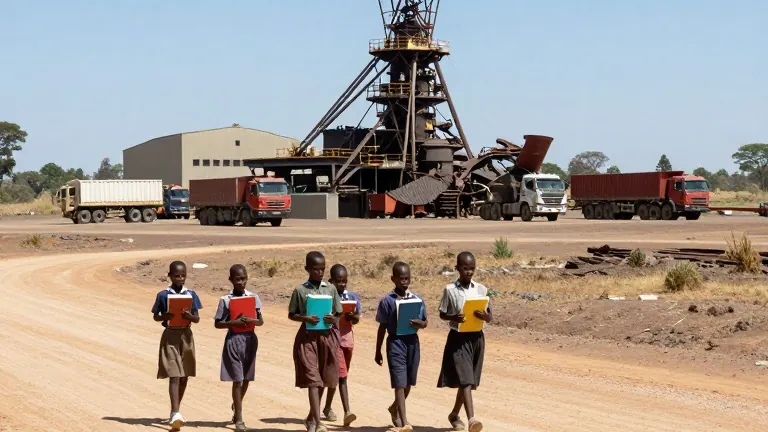
Access to education remains a pressing issue for families near the mines. Emmah Chikwai, a Ward 3 Councillor, noted that children from villages including Jompani, Majoki, Maleti, and Makwavarara walk between 15km and 25km to reach Musinambi Secondary School. She appealed to the mines to help establish a satellite secondary school in Makwavarara. In Turf Primary School, pupils were seen learning under trees as rising enrolment strained existing facilities.
Water quality and sanitation concerns are also mounting in the area. Edson Mabure, whose family was relocated as mining activities expanded, said the Ngwazani River, located about 100 meters from a dump site, is now flooded with sewage from the mine. Agnes Handidikundiona, a resident, explained that the water is no longer clean enough for domestic purposes or watering gardens. She added that flooding frequently prevents children from reaching school, creating a need for a footbridge.
Livelihoods in the region have adapted to the mining environment. Sakina Lice, a mother of 11 and grandmother of 9, said she supports her family by collecting plastic from waste piles to resell. She earns approximately $20 a month from this work and hopes the mine will empower women to start projects. Sakina noted that her husband is deceased, making her the sole breadwinner in her household.
Other platinum-producing areas are reporting similar gaps. Bulle Madzitire, chairman of the Shurugwi Residents Association, urged the Unki Platinum Mine to assist with classroom blocks, water, sanitation, and roads in Shurugwi town. Kamino Simango, chairman of the Zvishavane Residents Association, said the Mimosa Platinum Mine should focus more on infrastructure benefiting the wider community.
Unki told Al Jazeera that it has invested an average of $1.5 million annually in community development over the past five years. Evelyn Mawimba, the mine’s public relations manager, said the company has built 63 boreholes, supported 32 schools through its STEP-UP program, and contributed $2.75 million toward land purchases for the Impali housing estate. Unki also pays about $130,000 a year in municipal levies to the Shurugwi Town Council and $850,000 annually to the Tongogara Rural District Council. Zimplats and the Mhondoro-Ngezi Rural District Council did not respond to questions by publication time.
Source: Al Jazeera