Elfreth Hosts Maryland Domestic Violence Roundtable
The congresswoman gathered eight organizations in Severn to discuss federal funding and legislation aimed at preventing intimate partner violence.
By Jason Lee ·

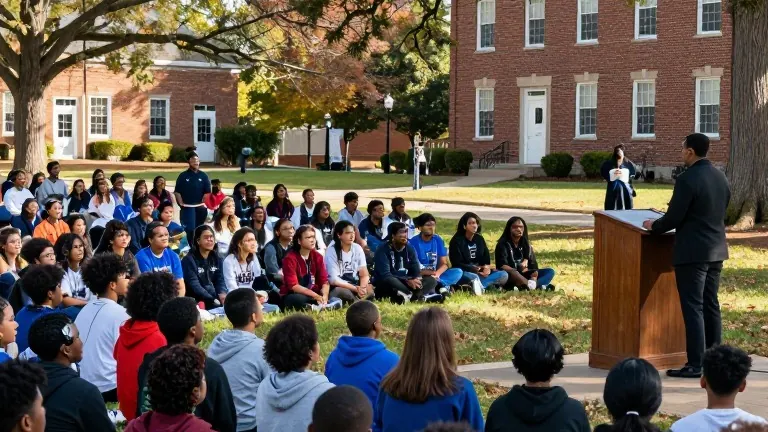
Severn, MD residents and local service providers gathered at a roundtable discussion hosted by Congresswoman Sarah Elfreth (MD-03) to address domestic violence in the state. The event took place yesterday, marking the second time the legislator has convened this specific group of partners during her first term in office. The meeting coincided with National Domestic Violence Awareness Month and focused on identifying effective solutions and coordinating future federal support.
Elfreth stated that one in three women and one in six men experience intimate partner violence, stalking, or harassment during their lifetimes. She emphasized that Maryland possesses dedicated partners who work daily to address these issues. The congresswoman said she is committed to delivering federal funding to nonprofits and introducing legislation that spreads Maryland's intervention practices nationwide.
Several local and national organizations participated in the discussion. Attendees included the Maryland Network Against Domestic Violence, the Maryland Coalition Against Sexual Assault, and the National Domestic Violence Hotline. Also present were TurnAround, Ujima: National Center on Violence Against Women in the Black Community, and the Johns Hopkins School of Nursing. The YWCA of Annapolis & Anne Arundel and Luminis Health Anne Arundel Medical Center’s DV Program also joined the conversation.
Kamila A. Alexander, PhD, MPH, RN, Associate Professor and Director of the BRAVE Center at Johns Hopkins School of Nursing, described domestic violence as a public health crisis. She argued that investment in science is imperative to reduce violence and its generational trauma. Alexander noted that implementing programs based on comprehensive research data offers an opportunity to save lives.
Amanda K. Rodriguez, Esq., CEO of TurnAround, said that while public attention may fade, the impact of domestic violence persists. She stated that survivors continue to rebuild their lives and seek safety long after headlines disappear. Rodriguez emphasized that the commitment to survivors must extend beyond moments of high public visibility.
Jennifer Pollitt Hill, Executive Director of the Maryland Network Against Domestic Violence, said the organization recognizes that domestic violence affects people across all socioeconomic statuses and political affiliations. She stated that the issue impacts healthcare systems, workplaces, and schools. Hill applauded Elfreth for bringing stakeholders together to keep domestic violence a priority for policymakers.
Jacquelyn Campbell, PhD, MSN, BSN, RN, FAAN, Professor at the Johns Hopkins University School of Nursing, outlined three levels of prevention required for the community. She said primary prevention must work with children who witness domestic violence. Secondary prevention should help those experiencing or using violence access services early. Tertiary prevention must assist severely abused individuals and hold perpetrators accountable through research-based interventions rather than purely punitive measures.
Lisae C. Jordan, Esquire, Executive Director & Counsel of the Maryland Coalition Against Sexual Assault, appreciated Elfreth's efforts to keep federal funding for sexual assault survivors out of political crossfire. Molly Knipe, CEO of the YWCA of Annapolis & Anne Arundel County, thanked the congresswoman for her long-standing commitment to expanding services through emergency residential facility funding and policy work.
In January of this year, Elfreth secured $697,000 in federal funding for the YWCA of Annapolis and Anne Arundel County. This money supports the Rapid Rehousing and Abuser Intervention Program in Maryland’s Third District. The funding bolsters domestic violence prevention initiatives, education, and rehousing resources.
In February, Elfreth introduced the bipartisan Preventing Domestic Violence Homicides Through Lethality Assessment Training and Technical Assistance Act. The bill would authorize a national training center to promote lethality assessment programs. These programs help law enforcement identify high-risk victims and connect them with local services. The model was developed by the Maryland Network Against Domestic Violence in 2005 and is honored as a promising practice by the Department of Justice.
As a member of the House Armed Services Committee, Elfreth secured two provisions in this year’s National Defense Authorization Act. The first provision authorizes $10 million for a modern data management system for Harmful Behavior Prevention programs in the military. The second provision strengthens the Military Protective Order process. It requires Department of Defense and Coast Guard commanders to decide MPO requests within three calendar days and notify requesters in writing within two calendar days of a denial.
Elfreth has hosted 12 roundtables with local stakeholders in her first term. Topics have included education, veterans issues, the environment, child care, and labor. The National Domestic Violence Hotline remains available at 1-800-799-SAFE for immediate help.
Source: Baltimore Times