
Lakeport Plantation: 155 Slaves and 4,400 Acres in 1850s
Researchers at the Arkansas State University heritage site continue to identify enslaved people and document the property's wartime losses.
By Jason Lee ·
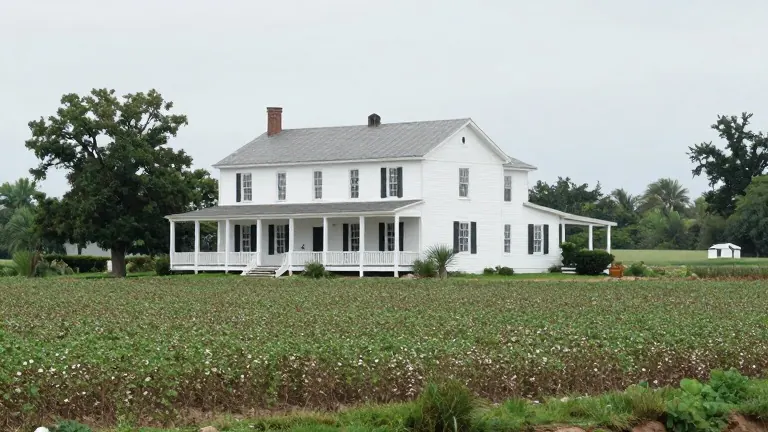
A Greek Revival house in Chicot County, Arkansas, stands as a physical record of antebellum cotton wealth and Civil War disruption. Joel Johnson sold his Kentucky farm and mill in 1831 to move to the Mississippi River, where he established a cotton operation. He died in 1846 owning about 95 enslaved people. His son, Lycurgus Johnson, inherited the bulk of the property.
Cotton prices rose sharply in the 1850s. Lycurgus Johnson expanded the holding to more than 4,400 acres and 155 enslaved people. He began building the current house near a river oxbow in the late 1850s. The structure contains 17 rooms and covers about 8,000 square feet. It is the only remaining plantation house in Arkansas that faces the river. A large earthen levee now blocks the view, but cotton fields still surround the property.
The house opened to the public in 2007. It serves as one of Arkansas State University’s heritage sites. Museum Director Ruth O’Loughlin stated that the site attracts thousands of visitors annually. Active research continues to identify the specific individuals who were enslaved there. O’Loughlin noted that the names of everyone enslaved are not yet known.
The Civil War transformed the local economy. Arkansas seceded in May 1861. Confederate leaders expected European textile industries to force Britain and France to support the South. Those nations instead imported more cotton from Egypt. Union forces moved down the Mississippi River, capturing New Orleans and western Tennessee. They targeted the ports of Helena and Vicksburg.
Vicksburg fell on July 4, 1863. Union control of the river split the Confederacy in half. Local economies suffered. Union and Confederate armies foraged in Chicot County. Partisan bands took supplies from residents. In 1863 or 1864, Union soldiers arrived at Lakeport and took all mules, horses, and cattle. The Encyclopedia of Arkansas describes the conflict in the area as a brutal guerrilla war.
Lycurgus Johnson retained his formerly enslaved workers after the war. By 1870, the plantation produced about 600 bales of cotton per year. This output was half of pre-war levels but remained profitable. The property stayed in the Johnson family until 1927. Russian immigrant Sam Epstein bought the house and land for $30,000. The Epstein family expanded the property to 13,000 acres. The house was abandoned for more than 30 years. Sam Epstein Angel gave it to Arkansas State University in 2001 after visiting a restored historic home in Piggott.
Adam Long, executive director of Arkansas State University Heritage Sites, said Epstein Angel was impressed by that restoration project. The university reopened the site in 2007. Researchers continue to document the site’s history. O’Loughlin said the work involves adding to the historical record of the landmark in southeastern Arkansas.
Source: Talk Business & Politics