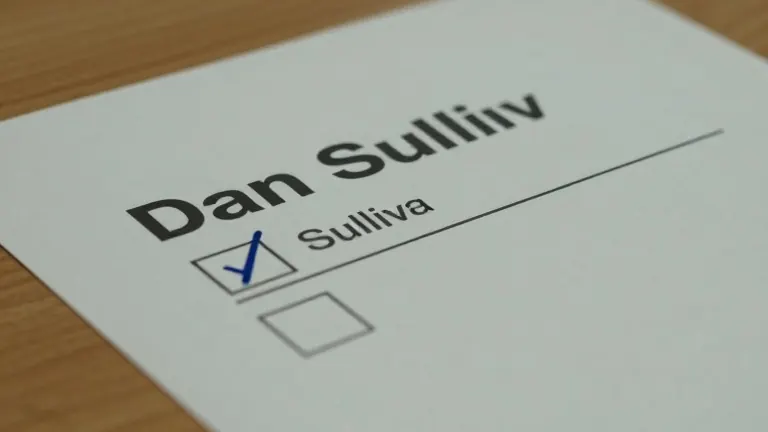
Alaska Governor Orders Probe Into Senate Race After Report on Dual Sullivan Candidacies
State officials move to investigate allegations that Democratic operatives recruited a rival candidate with the same name as the Republican incumbent.
By Chloe Martin ·
Governor Mike Dunleavy ordered an investigation into the state's U.S. Senate race on Wednesday after reports emerged that Democratic campaign staff may have recruited a second candidate named Dan Sullivan. The probe aims to determine if the presence of the non-incumbent candidate violated state laws and whether criminal or civil actions are warranted. The dispute has intensified in the days before Election Day, with both parties accusing the other of manipulating the ballot.
The conflict centers on two candidates sharing the name Dan Sullivan. The incumbent is a Republican seeking to retain the seat. The other Sullivan is a non-incumbent who advanced to the general election ballot after the state's nonpartisan primary. A recent report from The New York Times detailed efforts by Democratic operatives to recruit the second candidate, a move Republicans have long alleged was a strategy to confuse voters and split the vote against the incumbent.
The timeline of the dispute began when the non-incumbent Sullivan qualified for the general election in the primary. In June, the Alaska Supreme Court ruled that he could appear on the ballot. Last week, the Justice Department under President Trump sought to intervene in the race. The department asked a court to delay the certification of results if the incumbent lost by a small margin, citing potential voter confusion caused by the duplicate names.
The New York Times based its story on interviews and communications with attorneys, advisers for Democrat Mary Peltola, and senior aides at the Democratic Senatorial Campaign Committee. Peltola, a former congresswoman, is the Democratic nominee seeking to flip the seat. Both the Peltola campaign and the DSCC reiterated their long-standing denials of involvement in the second Sullivan's candidacy after the report published. Peltola called the story a distraction while campaigning Wednesday.
Republican leaders moved quickly to capitalize on the reporting. Nate Adams, a spokesperson for the incumbent, stated that the Peltola campaign had spent months denying a scheme it was running all along. President Trump posted online that the findings represented voter fraud at the highest level. Justice Department officials said Thursday that the new reporting expands their options for investigating the race. They filed an amended complaint citing the specific details from the Times report.
Election law experts initially criticized the Justice Department's legal intervention as weak. Many argued that the Constitution grants states primary control over their elections. Elaine Kamarck, a senior fellow at the Brookings Institution, noted that such tactics are common in politics. She observed that the internet makes it easy to spread information about campaign tricks or corrections to those tricks.
Some voters compared the situation to spending by Republican groups in support of a Democratic federal prisoner who is also on the state's U.S. House ballot. The ballot includes a notation identifying the Republican as the incumbent. Some experts suggest the recent media attention may reduce voter confusion rather than increase it. Additionally, Alaska uses ranked-choice voting in the general election, allowing voters to rank both Sullivans without ranking Peltola if they are unsure.
The Department of Public Safety is now tasked with the investigation ordered by Governor Dunleavy. It is unclear which specific laws may have been violated. The state's unique election system is also a question on the general election ballot, where voters will decide whether to keep the current format.
The second Sullivan did not respond to requests for comment regarding the new allegations. He has previously stated that running for Senate was his own decision. The investigation will proceed while the state prepares for the vote, which could determine control of the Senate for the coming year.
Source: WYPR